
Getting School Approval for an International Sports Trip: The Professional Guide
Your school board isn't interested in the final score of a match in Buenos Aires; they are focused on how that experience transforms a student into a resilient, global citizen. You understand that elite athletic travel is a vital catalyst for character development, yet the path to getting school approval for an international sports trip is often blocked by bureaucratic resistance and liability concerns. It's frustrating when a transformative opportunity is dismissed as merely a holiday because the educational value wasn't articulated with professional precision.
We're here to bridge that gap. This guide provides a strategic roadmap to master the administrative process and secure board approval by aligning elite athletic rigor with your school's academic mission. You'll learn how to manage the latest 2026 EU biometric entry requirements, address financial equity with concrete strategies, and utilize a professional proposal template designed to satisfy even the most cautious administrators. By the end of this article, you'll have the tools to prove that high-performance travel isn't just an extra; it's an essential pillar of a world-class education.
Key Takeaways
- •Learn how to redefine your tour as an athletic immersion program that directly supports your school's mission to develop leadership and global citizenship.
- •Discover a systematic framework for getting school approval for an international sports trip by addressing institutional liability through dynamic risk assessments.
- •Master financial transparency with strategies for inclusive participation, ensuring elite training opportunities remain accessible to talented athletes from all backgrounds.
- •Understand how to assemble a multi-disciplinary Tour Committee to craft a high-impact proposal that justifies the necessity of high-performance travel in 2026.
- •Explore why specialized sports travel expertise is essential for managing the complex logistical nuances of elite fixtures and on-the-ground support in professional environments.
Aligning International Sports Tours with School Educational Charters
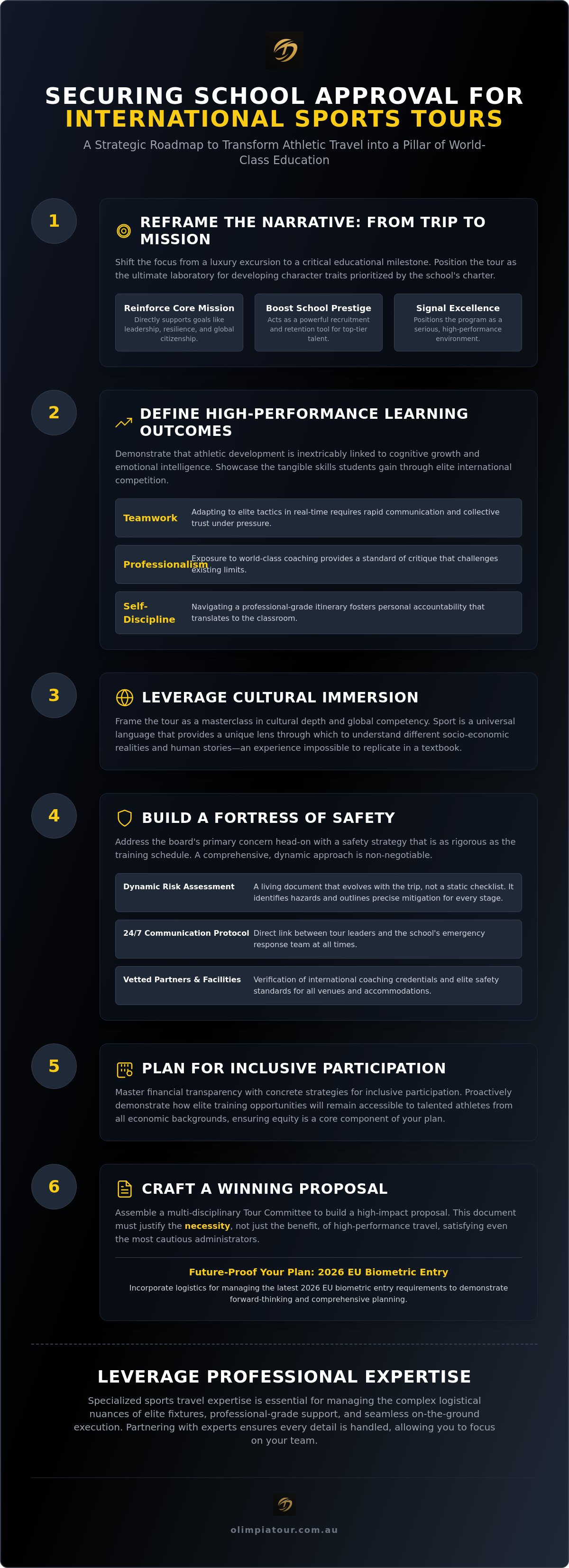
Success in getting school approval for an international sports trip hinges on your ability to transform the narrative from a luxury excursion to a critical educational milestone. Most school boards evaluate proposals through the narrow lens of risk versus reward. To move the needle, you must demonstrate how the tour reinforces the institution’s core mission. If the school charter prioritizes resilience, leadership, or global citizenship, your proposal should position the tour as the ultimate laboratory for these traits. Unlike a standard holiday, an athletic immersion program is a disciplined, methodology-driven environment where every drill and fixture serves a specific pedagogical purpose.
Schools that offer these elite experiences often see a direct impact on the caliber and prestige of their sports programs. These tours act as powerful recruitment and retention tools, signaling to prospective families that the school is committed to a pathway of excellence. It positions your program as a serious, high-performance environment that honors the educational value of school trips by applying academic rigor to the playing field. When students see a clear route to international exposure, their engagement with the school's broader mission intensifies.
Defining High-Performance Learning Outcomes
Athletic development is inextricably linked to cognitive growth and emotional intelligence. When a student-athlete competes in a high-stakes environment abroad, they aren't just practicing a sport; they're developing "grit" through exposure to unfamiliar competitive styles. Key outcomes include:
- •Teamwork under pressure: Adapting to elite tactics in real-time requires rapid communication and collective trust.
- •Professional Feedback: Exposure to world-class coaching provides students with a standard of critique that challenges their existing limits.
- •Self-Discipline: Navigating a professional-grade itinerary fosters a level of personal accountability that translates directly to the classroom.
The Cultural Immersion Factor as a Global Competency
Sport is perhaps the only truly universal language. By taking a team to world-renowned sporting hubs like Buenos Aires or Rosario, you're offering students a masterclass in cultural depth. They witness firsthand the intense passion and different socio-economic realities that shape the lives of their opponents. This isn't just about seeing a new city; it's about understanding the human stories behind the competition. This profound immersion develops a global perspective that is impossible to replicate in a textbook, making the process of getting school approval for an international sports trip a much easier sell when framed as a necessity for the modern, global-minded student.
Navigating Risk Assessment and Student Safeguarding Abroad
The primary obstacle to getting school approval for an international sports trip is almost always the perception of risk. School boards and administrators are rightfully protective of their students and their institution's reputation. To overcome this, you must present a safety strategy that is as rigorous as your training schedule. A standard checklist isn't enough. You need a Dynamic Risk Assessment that evolves with the trip, covering everything from the security of the accommodation to the specific physical demands of high-intensity match-play against local clubs. This document should serve as a living blueprint that identifies potential hazards and outlines precise mitigation strategies for every stage of the journey.
Developing a Comprehensive Safety Management Plan
Effective safeguarding begins long before the team reaches the airport. It starts with meticulous pre-departure briefings where parents and students are educated on the high standards of conduct expected in professional environments. On the ground, safety is maintained through a 24/7 communication protocol that links the tour leaders directly to the school's emergency response team. You must also verify that international partners possess the correct coaching credentials and that facilities meet elite safety standards. This includes mapping out local hospital networks and ensuring access to sports-specific physiotherapy, as standard medical care often lacks the specialized focus required for elite student-athletes. Vetting local staff through rigorous background checks is a non-negotiable step in maintaining your school’s duty of care. For organizations seeking to reinforce these safeguards with robust legal frameworks, Matthew Fornaro, P.A. provides the business law expertise necessary to ensure all liability and service contracts are professionally vetted.
Legal Indemnity and Insurance Requirements
Institutional liability is a complex landscape, often requiring 'hold harmless' agreements and clear school district exoneration policies. Standard travel insurance rarely suffices for a high-performance tour. You need specialized sports travel insurance that specifically covers match-related injuries and emergency medical evacuation. Utilizing an elite provider like Olimpia Tour provides an essential extra layer of legal protection, as we handle the rigorous vetting of local vendors and transport providers. By leveraging our deep insider knowledge and established safety protocols, you transform the conversation from a debate about liability into a demonstration of professional oversight. This level of preparation reassures the board that every variable has been calculated, allowing the focus to remain on the transformative athletic experience. When you present a proposal that anticipates every legal and safety contingency, the path to getting school approval for an international sports trip becomes significantly smoother.
Financial Planning and Inclusive Participation Strategies
Securing the green light from a school board requires more than just athletic justification; it demands a masterclass in financial transparency. Financial equity is a primary concern for administrators who fear that elite opportunities might exclude talented students based on their socio-economic background. To address this, your proposal must move beyond a simple "price per head" and present a comprehensive Total Cost of Participation (TCP) model. This level of detail demonstrates professional oversight and ensures that parents aren't blindsided by hidden fees for hydration, local transport, or specialized kit once the team is already on the ground. A transparent budget is a powerful tool for getting school approval for an international sports trip because it replaces administrative anxiety with a clear, manageable roadmap.
Planning should begin at least 12 to 18 months in advance to facilitate structured payment schedules. Early bird planning doesn't just reduce financial stress; it allows the school to leverage the cost-effectiveness of bundled high-performance packages. When you compare the price of a curated experience like the Buenos Aires Football Experience to the fragmented costs of individual travel, the value proposition becomes undeniable. Professional tours consolidate elite coaching, professional fixtures, and secure logistics into a single, high-value investment that is far more efficient than any piecemeal arrangement.
Transparent Cost Analysis for Boards
A successful proposal breaks down the logistical machinery of the tour to show exactly where every dollar is allocated. Boards appreciate seeing a "Value for Money" comparison that highlights the exclusive access students receive. Your analysis should include:
- •Bundled Logistics: Explain how inclusive packages for accommodation, meals, and secure transport reduce overall institutional risk.
- •Professional Essentials: Account for high-performance necessities such as match-play insurance, which typically costs between 5% and 7% of the total trip cost based on 2026 industry data.
- •Defined Exclusions: Provide a starkly clear list of what isn't included, such as personal spending money or specific visa fees like the ETIAS authorization required for late 2026 travel.
Ensuring Equitable Access to the Tour
True excellence is inclusive. To satisfy board requirements for diversity, you must integrate strategies that support talented athletes from all backgrounds. This might involve creating "scholarship" spots funded through community engagement or corporate sponsorships. Research from 2019 indicates that the average family spends around $408 annually on school sports; an international tour is a significant step up that requires creative fundraising. Encourage the team to "earn" their journey through local service projects, which builds character and reinforces the school’s mission. Finally, communicate the long-term ROI to parents and boards. This isn't just a trip; it's a gateway to university pathways and professional scouting environments that can shape a student's entire future. When the financial narrative focuses on transformative value, getting school approval for an international sports trip becomes a shared goal rather than a bureaucratic hurdle.
Crafting a Winning Proposal for the School Board
Securing the green light for an elite tour requires more than just a passion for the game; it demands a structured, multi-disciplinary approach that leaves no room for administrative doubt. You shouldn't attempt this as a solo mission. Instead, assemble a dedicated Tour Committee comprising the lead coach, a parent representative, and a senior administrator. This collective front demonstrates that the initiative has broad institutional support and that various stakeholders have already vetted the logistical and financial implications. A collaborative proposal carries a weight of authority that a single department's request simply cannot match.
Your Executive Summary must be punchy and purposeful, providing three undeniable reasons why getting school approval for an international sports trip is a priority for 2026. First, emphasize the necessity of professional oversight in light of the EU’s Entry/Exit System (EES) fully operating as of April 10, 2026, which requires complex biometric registration for groups. Second, highlight the post-pandemic shift toward "intentional travel," where high-performance environments serve as a vital antidote to student disengagement. Third, position the tour as a response to the growing global trend of competitive intercontinental fixtures, ensuring your school remains at the forefront of athletic excellence. This isn't just about a trip. It's about maintaining your institution's elite status in a rapidly evolving sporting landscape.
The Anatomy of a High-Impact Proposal
A professional proposal should be segmented to address the specific concerns of different board members. Structure your document into three distinct pillars:
- •Athletic Objectives: Detail the specific coaching clinics and high-stakes fixtures that will challenge your athletes beyond their local limits.
- •Educational & Cultural Integration: Explicitly link the itinerary to the school’s curriculum, focusing on language immersion, historical context, and global citizenship.
- •Logistics, Budget, and Risk Mitigation: Present a transparent financial model alongside a "Safety First" appendix that proactively answers the board's toughest questions regarding liability and safeguarding.
Evidence-Based Justification
Numbers and narratives are your strongest allies. Use data from previous tours to showcase improvements in student retention and "school spirit." Boards are often swayed by the success of peer institutions, so include testimonials from other schools that have successfully navigated high-performance hubs. For a definitive benchmark of quality, point to the Buenos Aires Football Experience as an example of how elite athletic development and cultural immersion can be seamlessly integrated. This level of professional evidence transforms your proposal from a "request" into a compelling strategic recommendation. If you are ready to begin building your professional proposal, contact our expert team today to access the specific data and testimonials you need to win board approval.
Leveraging Professional Sports Travel Expertise for Seamless Approval
A general travel agency excels at booking leisure itineraries, but they often lack the specialized infrastructure required to manage the high-stakes environment of an elite athletic tour. When you are getting school approval for an international sports trip, your board needs to know that the training environments are professionally vetted and that the competitive fixtures are managed with surgical precision. A generic agent cannot guarantee access to AFA-licensed facilities or ensure that your team is matched against level-appropriate opponents who will challenge, rather than discourage, your athletes. By partnering with a sports-first specialist, you transition from being a travel coordinator to a high-performance director, backed by a team that understands the methodology behind every drill.
The presence of local, on-the-ground support in hubs like Buenos Aires or Rosario is the ultimate insurance policy for an institution. These are cities where sport is a way of life, and having a guide who possesses deep insider knowledge ensures that your team moves through these environments with security and prestige. Your tour operator should act as a consultant to the school board, taking on the "heavy lifting" of dynamic risk assessments and logistical oversight. This professional partnership allows the board to see that the school’s duty of care is being managed by experts, making the decision to approve the journey a logical step toward excellence.
The Value of Specialized Athletic Networks
Exclusivity is the hallmark of a truly transformative tour. Specialized networks provide access to professional club fixtures that are simply unavailable to the public, offering your students a rare glimpse into the life of a professional athlete. These connections ensure that every match is a meaningful learning opportunity, carefully selected to match your team’s skill level and maximize growth. When your proposal mentions methodology-driven clinics led by licensed professionals, it signals to the board that the trip is rooted in professional development rather than mere tourism. This evidence-based approach is often the deciding factor in getting school approval for an international sports trip.
The Olimpia Tour Advantage
Our role is to serve as your professional mentor throughout the entire administrative process. We assist coaches in preparing their board presentations, providing the data and safety documentation required to win over even the most skeptical administrator. Whether you are organizing a rugby tours to Argentina or a volleyball immersion, our commitment to elite standards remains absolute. We significantly reduce the administrative burden on teachers, handling the complex logistical nuances so that you can focus on what matters most: coaching your athletes to their full potential. With our global-local perspective, we ensure your tour is not just a trip, but a life-changing professional and personal milestone.
Elevating Your Program to the Global Stage
The process of getting school approval for an international sports trip is a strategic negotiation that demands a sophisticated blend of athletic ambition and administrative rigor. You have the power to transform a logistical challenge into a prestigious institutional milestone by aligning your tour with the school’s core mission of developing resilient, global citizens. Success is found in the meticulous details; it requires a transparent financial roadmap and a safety strategy that prioritizes student safeguarding above all else. When you present a proposal rooted in methodology and evidence, you move beyond the "if" and focus entirely on the "when."
As specialists in elite Argentine sporting methodology, we provide the comprehensive risk management and exclusive access to top-tier professional club fixtures that school boards demand. We act as your professional mentor, ensuring your athletes experience the intensity of world-class competition while maintaining the highest organizational standards. Download our School Board Proposal Template and start planning your Argentine experience to bridge the gap between your program's current limits and its global potential. The journey to excellence starts with a single, professional step; we are ready to help you take it.
Frequently Asked Questions
How far in advance should I start the school approval process for an international trip?
You should initiate the school approval process at least 12 to 18 months before your intended departure date. This timeline allows for the rigorous administrative vetting required by most boards and accommodates the structured payment schedules necessary for inclusive participation. It also ensures you can secure fixtures against elite clubs that often finalize their seasonal calendars well in advance of the competitive year.
What are the most common reasons school boards reject sports tour proposals?
Boards typically reject proposals due to perceived institutional liability or a failure to distinguish the tour from a standard holiday. If you don't articulate clear, high-performance learning outcomes, administrators may view the trip as a distraction from academic goals. Proactively addressing these concerns with a dynamic risk assessment is the most effective strategy for getting school approval for an international sports trip.
Does the school need to pay for the coaches' travel and expenses?
The cost of staff travel is traditionally built into the overall tour price as a supervision overhead, or it's subsidized through the school’s professional development budget. Since teachers are acting as 24/7 guardians and technical mentors, their presence is a non-negotiable component of the safety management plan. Transparently communicating these costs to parents ensures the tour remains a professionally managed educational experience with appropriate oversight.
How do I handle parents who are worried about safety in South America?
Address parental concerns by providing specific evidence of your operator’s local security protocols and 24/7 on-the-ground support in cities like Buenos Aires or Rosario. Highlighting that your group will stay in professional-grade facilities and travel via private, vetted transport often alleviates anxiety. You should also emphasize the industry recommendation for emergency medical coverage of at least $100,000 for students to prove comprehensive preparation.
Can we include students who aren't on the first team in an international tour?
You can certainly include developing athletes, provided the itinerary includes fixtures tailored to their specific skill level to ensure safety and maximize growth. A high-performance tour is an exceptional tool for program-wide development and student retention. By creating developmental brackets, you reinforce the school’s mission of inclusive excellence while exposing more students to elite Argentine methodology and professional environments.
What is the best way to present the 'educational' side of a football or rugby trip?
Present the tour as a masterclass in global citizenship where students navigate different socio-economic realities through the universal language of sport. Focus on cognitive development, such as decision-making under pressure and cross-cultural communication. Framing the experience as an athletic immersion program rather than a series of matches helps administrators see the profound personal milestones that occur both on and off the pitch.
How do I vet an international sports tour operator for safeguarding compliance?
You should demand proof of rigorous background checks for all local staff and verify that coaching clinics are led by licensed professionals, such as AFA-certified coaches. Ask for a detailed safety management plan that outlines specific protocols for medical emergencies and transport security. A reputable operator will act as a consultant during the process of getting school approval for an international sports trip, providing all necessary documentation.
Is a school sports trip to Argentina considered a high-risk activity?
An organized sports tour to Argentina is categorized as a managed-risk activity, provided you follow established planning standards for activities outside your home country. While match-play carries inherent physical risks, these are mitigated through level-appropriate fixtures and professional medical oversight. By utilizing an elite tour operator with deep local expertise, you ensure that every variable is calculated, transforming a perceived risk into a controlled, transformative milestone.
Plan your next sports tour
Olimpia Tour is a global sports tour operator, building fully managed tours for schools, clubs and academies worldwide — across Europe, Asia, Africa, Oceania, the Middle East and the Americas.